WHAT IF YOU COULD FINALLY UNDERSTAND THE HIDDEN MEANING BEHIND CERTAIN AFRICAN SYMBOLS, ANIMALS, OBJECTS, AND ANCESTRAL TRADITIONS?
There are stories that have been told for generations.
Symbols that appear on ancient objects.
Animals that hold a special place in certain stories.
Trees, places, words, and ceremonies to which some communities attribute profound meaning.
But how many people truly understand the history and context behind these traditions?
Many people search for answers online, encounter contradictory information, and eventually end up mixing authentic traditions with modern interpretations and popular myths.
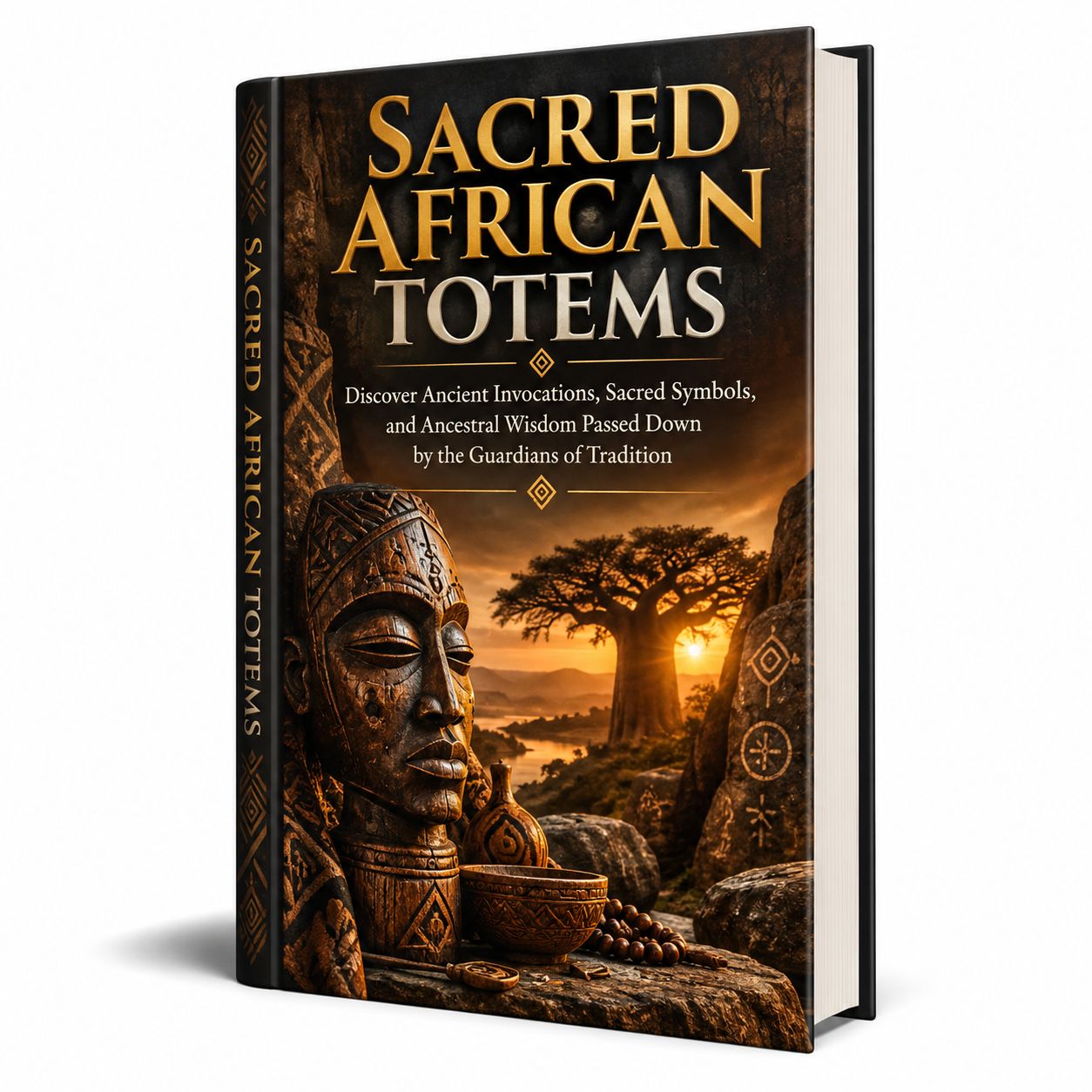
SACRED AFRICAN TOTEMS invites you to go deeper.
This guide takes you into the world of symbols, totems, ancestral memory, nature, invocations, and the transmission of traditional African knowledge, through an accessible, structured approach that respects the diversity of African cultures.
HAVE YOU EVER ASKED YOURSELF THESE QUESTIONS?
Why do certain animals hold a special place in some African traditions?
Why are certain trees, objects, or symbols considered important?
What do traditional patterns really represent?
How did elders pass their knowledge down to younger generations?
What place do ancestors hold in certain traditions?
What does a traditional invocation actually mean?
And above all...
How can you distinguish genuine cultural richness from modern interpretations that circulate everywhere online?
If these questions interest you, this guide was created for you.
THE REAL PROBLEM
Today, it is easy to find information about African traditions.
But it is much harder to find a presentation that places each element within its cultural context.
❌ You find lists of “sacred animals” without knowing which community they actually belong to.
❌ You discover symbols whose meanings are presented as universal, even though they may vary from one culture to another.
❌ You read supposed “ancient invocations” without knowing whether they actually come from a documented tradition.
❌ You want to understand ancestral traditions, but you don't know where to begin.
❌ You encounter sensational claims that mix history, spirituality, folklore, and modern inventions.
❌ You want to reconnect with your cultural roots, but you lack a clear method for exploring these subjects.
The problem is not your curiosity.
The problem is the lack of context.
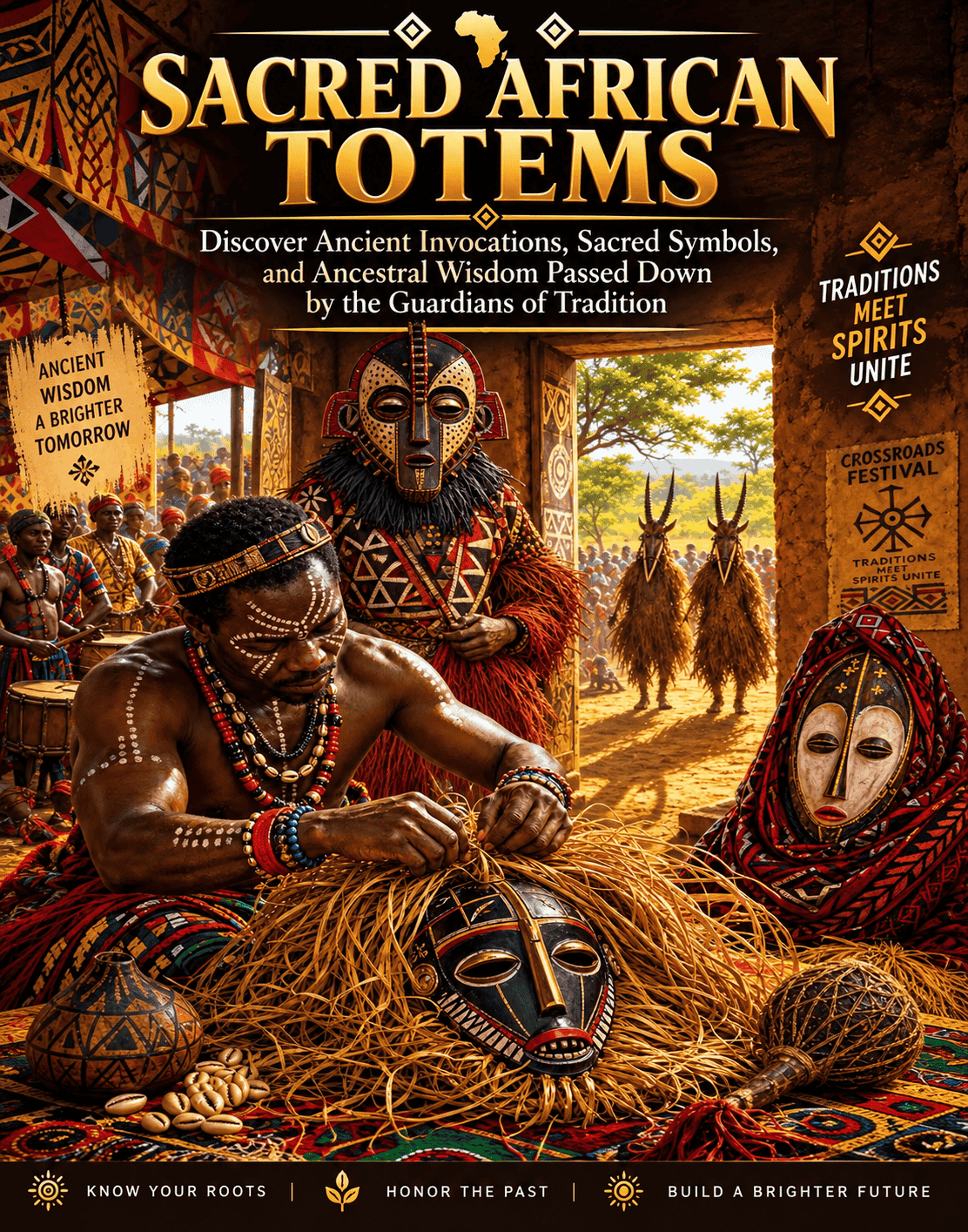
✅ THE SOLUTION: SACRED AFRICAN TOTEMS
SACRED AFRICAN TOTEMS is a guide designed to help you explore African traditions through their symbols, animals, plants, objects, invocations, stories, ancestors, and methods of transmission.
Instead of presenting you with a simple collection of “secrets,” the guide helps you understand how these elements can take on meaning within their cultural context.
You will discover how:
🌿 nature can be connected to memory, identity, and tradition;
🦁 certain animals can become symbols of values, stories, or identity;
🌳 trees and landscapes can hold particular significance within certain communities;
🔱 symbols and patterns can transmit stories and values;
🗣️ words, songs, prayers, and invocations can participate in oral transmission;
👴 elders and knowledge keepers can play an important role in preserving traditional knowledge;
🏺 traditional objects can have artistic, historical, family, or ritual value.
🎯 THE TRANSFORMATION
BEFORE
You see a symbol...
→ but you don't understand its context.
You discover an animal associated with a tradition...
→ but you don't know whether that meaning is truly universal.
You hear about ancient invocations...
→ but you don't know how to distinguish documented tradition from modern invention.
You want to discover ancestral wisdom...
→ but you don't know where to begin.
AFTER
🎯 You gain a better understanding of the concept of totems and its cultural diversity.
🎯 You understand why context is essential when interpreting a symbol.
🎯 You discover the role animals, trees, and nature can play in different traditions.
🎯 You gain a clearer understanding of oral transmission and the role of elders.
🎯 You discover the cultural place of invocations, prayers, songs, and traditional words.
🎯 You develop a more conscious and respectful approach to African traditions.
You no longer simply look at the symbols.
You begin to understand the stories and values that may exist behind them.
📖 WHAT YOU WILL DISCOVER INSIDE THE GUIDE
📌 01 — Understanding African Totems
Discover what is meant by “totem” and why this concept cannot be applied identically to every African culture.
You will understand:
- the concepts of symbols and identity;
- connections with family and community;
- intergenerational transmission;
- the importance of cultural context;
- why generalizations should be avoided.
🦁 02 — Sacred Animals and Their Symbolism
Explore the place certain animals can occupy within stories and symbolic systems.
You will discover examples involving:
- the lion;
- the elephant;
- the serpent;
- the leopard;
- the crocodile;
- the tortoise;
- birds.
The goal is not to assign one universal meaning to every animal, but to understand how communities develop their own meanings and associations.
🌿 03 — Trees, Plants, and the Wisdom of Nature
Discover how nature can be connected to memory, traditional practices, and identity.
You will explore:
- the symbolism of trees;
- the baobab;
- roots and continuity;
- traditional plant knowledge;
- water and landscapes;
- the protection of natural spaces.
🔱 04 — Symbols and Their Language
Learn to look differently at traditional patterns, forms, and representations.
You will discover:
- geometric patterns;
- sculptures;
- masks;
- colors;
- repeated forms;
- the relationship between symbols and stories;
- the importance of context.
👵 05 — Ancestors and the Memory of Generations
Discover how family and ancestral memory can be preserved and passed down.
This chapter explores:
- family memory;
- the role of elders;
- stories passed from one generation to another;
- remembrance ceremonies;
- lineages;
- cultural heritage;
- responsibility toward future generations.
🗣️ 06 — The Guardians of Wisdom
Who transmits traditional knowledge?
Discover the possible roles of:
- elders;
- storytellers;
- artisans;
- traditional healers;
- ritual specialists;
- community historians;
- keepers of memory.
You will also understand why traditional learning can take place through observation, listening, practice, and guidance.
🔥 07 — Ancient Invocations and Oral Traditions
Discover the role of spoken words within different traditions.
You will explore:
- prayers;
- songs;
- invocations;
- blessings;
- words of praise;
- rhythm and repetition;
- oral transmission.
The guide also helps you distinguish between a culturally documented tradition and a modern formula incorrectly presented as an ancient invocation.
🌍 08 — Nature, Protection, and Community Rituals
Discover how certain practices can accompany important moments in life.
You will explore:
- rites of passage;
- community;
- protection as a cultural value;
- symbolic offerings;
- ceremonies;
- moments of transition;
- a sense of belonging.
🏺 09 — Sacred Objects, Amulets, and Representations
Discover why a traditional object cannot always be reduced to its physical appearance.
You will learn to distinguish between:
- artistic objects;
- cultural objects;
- family objects;
- ceremonial objects;
- symbolic representations;
- objects considered sacred within a particular context.
🔐 10 — The Boundaries of Sacred Knowledge
Is all knowledge meant to be shared?
This chapter explores essential questions surrounding:
- respect for traditions;
- permission;
- confidentiality;
- restricted knowledge;
- cultural appropriation;
- the reader's responsibility;
- the limits of reproducing certain practices.
🌱 11 — Keeping Ancestral Wisdom Alive Today
Discover how certain values can continue to inspire modern life.
The guide explores:
- respect for nature;
- solidarity;
- patience;
- family transmission;
- craftsmanship;
- discipline;
- memory;
- community responsibility.
🛡️ 12 — Honoring Traditions with Respect
Complete your journey with a responsible approach to continuing your learning.
You will discover how to:
- research reliable sources;
- listen to the voices of the communities concerned;
- avoid stereotypes;
- respect cultural boundaries;
- preserve memory;
- transmit knowledge responsibly.
💎 THE UNIQUE BENEFITS OF THIS GUIDE
✅ A structured approach
You no longer need to jump from one scattered piece of information to another. The topics are organized progressively.
✅ A respectful view of African diversity
The guide avoids presenting one tradition as representative of the entire continent.
✅ Accessible language
You don't need to be a historian, anthropologist, or specialist in traditional cultures to begin.
✅ An exploration of symbols and their context
You learn to look beyond appearances and explore the stories and values behind them.
✅ An approach to invocations without false promises
The guide focuses on their cultural, oral, and symbolic dimensions rather than guaranteed supernatural claims.
✅ A better understanding of ancestral transmission
Discover why elders, families, and communities play an important role in preserving traditional knowledge.
✅ A guide you can revisit
Each chapter can serve as a starting point for exploring a particular subject in greater depth.
WHO IS THIS GUIDE FOR?
SACRED AFRICAN TOTEMS may particularly appeal to:
🌍 People passionate about African cultures.
📚 Readers interested in history and ancestral traditions.
🌿 People fascinated by the relationship between nature, culture, and spirituality.
👨👩👧👦 Those who want to better understand family and intergenerational transmission.
🔱 People fascinated by symbols, totems, and traditional representations.
🗣️ Readers who want to understand the role of invocations and oral traditions.
✍️ Content creators, amateur researchers, and culture enthusiasts looking for a structured foundation for further exploration.
WHAT YOU MAY EXPERIENCE AFTER READING
Imagine being able to look at a traditional symbol and no longer see only its appearance.
Imagine understanding why certain stories have survived across generations.
Imagine discovering the possible connection between nature, memory, community, and identity.
Imagine finally having a structure for pursuing your own research instead of getting lost in contradictory information.
That is the experience of discovery that SACRED AFRICAN TOTEMS is designed to offer.
🚀 TAKE ACTION NOW
You can continue searching through scattered pieces of information...
Or you can begin a structured journey through totems, symbols, oral traditions, ancestors, nature, and African cultural wisdom.
You can continue wondering what these traditions mean...
Or you can begin exploring their history, context, and transmission.
You can rely on interpretations you happen to find online...
Or you can develop a more conscious and respectful approach.
👉 DOWNLOAD SACRED AFRICAN TOTEMS NOW
and begin exploring the richness of African symbols, traditions, and ancestral wisdom.
READER TESTIMONIALS
Amara C. ⭐⭐⭐⭐⭐
This guide helped me understand African symbols in a much deeper way. I especially appreciated the explanations about cultural context and the differences between traditions.
Daniel K. ⭐⭐⭐⭐⭐
The chapter about sacred animals was fascinating. I learned that the meaning behind an animal can depend greatly on the community and its traditions.
Grace M. ⭐⭐⭐⭐⭐
I really enjoyed the sections about ancestors, elders, and the transmission of wisdom. It made me want to learn more about the stories passed down in my own family.
Samuel O. ⭐⭐⭐⭐⭐
What stood out to me was how organized everything was. The guide made a complex subject much easier to understand without making it feel overly academic.
Naomi A. ⭐⭐⭐⭐
The part about symbols and traditional objects was my favorite. I now look at traditional patterns with much more curiosity and attention to their cultural background.
Michael T. ⭐⭐⭐⭐⭐
I had read many different things online about African traditions, but a lot of the information was confusing. This guide gave me a much clearer starting point for further learning.
Sandra E. ⭐⭐⭐⭐⭐
The sections about nature, trees, and ancestral memory were especially meaningful to me. The guide made me think differently about the connection between culture, nature, and generations.
Patrick B. ⭐⭐⭐⭐
A fascinating and easy-to-follow guide. I liked that it encourages readers to explore African traditions with curiosity while also showing the importance of respect and cultural context.